


Description
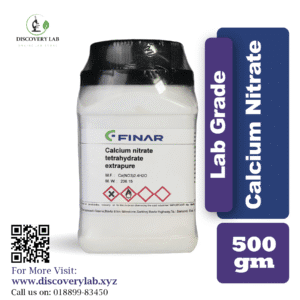
Lab-grade Calcium Nitrate is a high-purity inorganic salt with the chemical formula Ca(NO3)2. It serves as a fundamental reagent in various scientific disciplines, providing a readily available source of both calcium (Ca2+) and nitrate (NO3−) ions. Its consistent quality and well-defined properties make it indispensable for controlled experiments and analytical procedures in chemistry, biology, and agricultural research.
Product Description (16 Key Points):
- Chemical Formula: Its chemical formula is Ca(NO3)2, indicating its ionic composition. It often exists as a tetrahydrate, Ca(NO3)2⋅4H2O.
- Molar Mass: The anhydrous form has a molar mass of approximately 164.09 g/mol, while the tetrahydrate is around 236.15 g/mol.
- Appearance: Typically appears as colorless deliquescent crystals or a white crystalline solid.
- Solubility: Highly soluble in water, readily dissociating into calcium and nitrate ions. Also soluble in alcohol and acetone.
- Ionic Composition: Provides a readily available source of calcium cations and nitrate anions in aqueous solutions.
- Oxidizing Agent: Acts as a mild to moderate oxidizing agent, especially in concentrated solutions or at elevated temperatures.
- Hygroscopic Nature: Readily absorbs moisture from the atmosphere, requiring careful storage in airtight containers.
- Purity Grade: Manufactured to meet strict laboratory standards, ensuring minimal impurities for reliable and reproducible experimental results.
- Consistent Quality: Undergoes thorough quality control to guarantee uniformity across different batches.
- Versatile Reagent: A valuable reagent in diverse chemical, biological, and agricultural research settings.
- Source: Commonly produced by the reaction of nitric acid with calcium carbonate or calcium hydroxide.
- pH of Solution: Aqueous solutions tend to be slightly acidic due to the hydrolysis of the nitrate ion.
- Decomposition: Decomposes upon heating, releasing nitrogen oxides.
- Packaging: Typically supplied in tightly sealed containers of various sizes to prevent moisture absorption and maintain purity.
- Application Areas: Used in plant nutrition studies, soil analysis, wastewater treatment, and as a component in certain chemical syntheses.
Uses and Recommendation (6 Key Points):
- Source of Calcium Ions: Highly recommended when a pure and soluble source of calcium ions is required for biological or chemical experiments.
- Source of Nitrate Ions: Essential in studies investigating the effects of nitrate on biological systems, particularly in plant physiology and microbiology.
- Plant Nutrition Research: Widely used in hydroponic solutions and soil amendment studies to investigate calcium and nitrogen uptake by plants.
- Wastewater Treatment: Can be employed in specific wastewater treatment processes.
- Chemical Synthesis: Used as a reagent in certain chemical reactions and preparations.
- Soil Science: Recommended for analyzing and modifying soil composition, particularly in relation to calcium and nitrogen content.
Safety Precautions (5 Key Points):
- Oxidizer: Exercise caution as it is a mild to moderate oxidizing agent and can enhance the combustion of organic materials. Keep away from flammable substances.
- Irritant: May cause irritation to the skin, eyes, and respiratory tract. Avoid contact and inhalation. Wear appropriate personal protective equipment (gloves, goggles, lab coat, and mask if handling powder).
- Ingestion Hazard: Harmful if swallowed. Avoid ingestion. In case of ingestion, seek medical attention immediately.
- Water Solubility and Runoff: Due to its high water solubility, spills can easily dissolve and potentially contaminate water sources. Contain spills and dispose of properly according to local regulations.
- Storage: Store in a cool, dry, and well-ventilated area, away from incompatible materials, especially combustible materials and strong reducing agents. Keep containers tightly closed to prevent moisture absorption.




Reviews
There are no reviews yet.