

Description
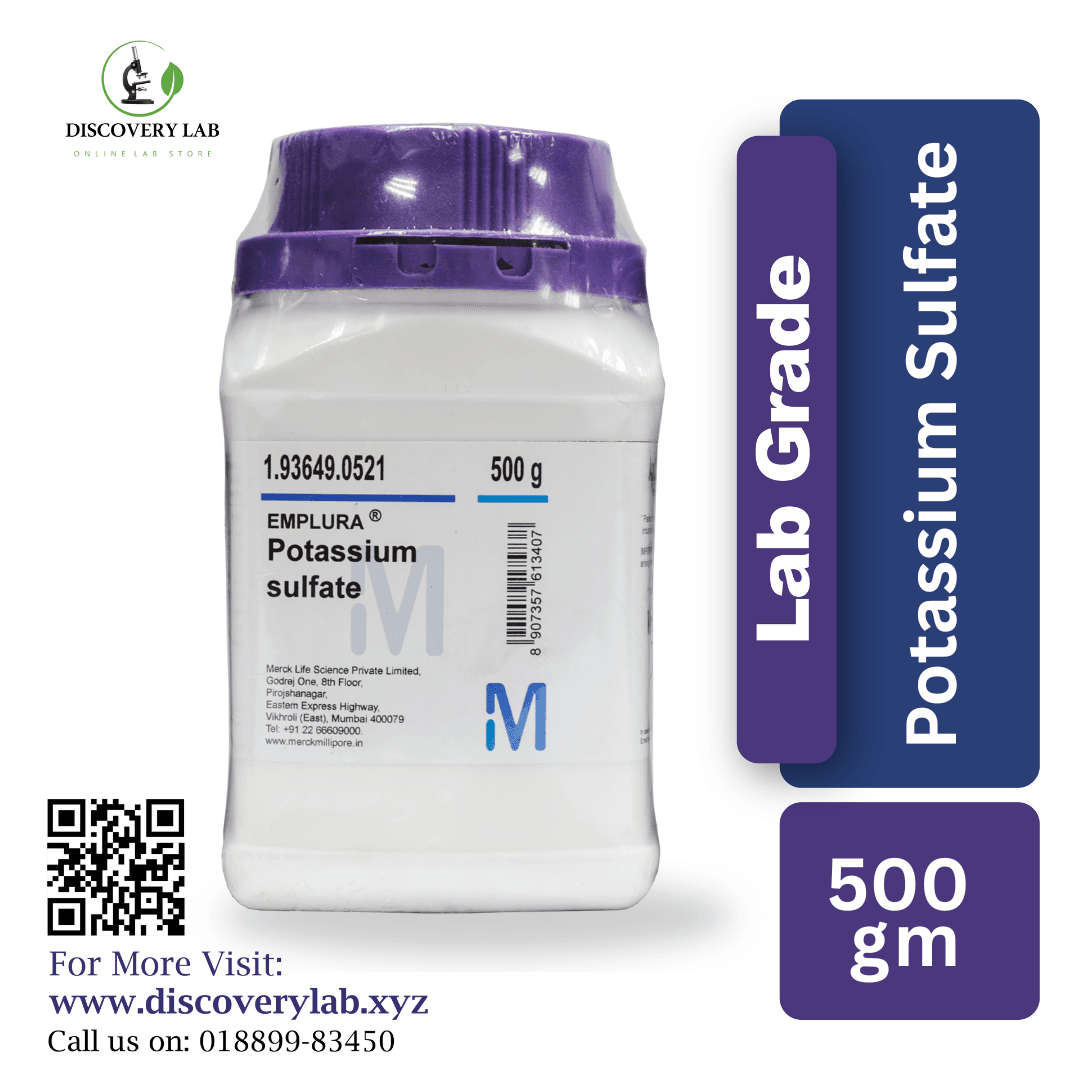
Lab-grade Potassium Sulfate is a high-purity inorganic salt, a fundamental source of potassium (K+) and sulfate (SO42−) ions for laboratory applications.
- Chemical Formula: Its chemical formula is K2SO4, indicating its ionic composition.
- Molar Mass: Possesses a molar mass of approximately 174.26 g/mol.
- Appearance: Typically appears as a white crystalline solid or powder.
- Solubility: Soluble in water, readily dissociating into potassium and sulfate ions.
- Ionic Composition: Provides a readily available source of potassium cations and sulfate anions in aqueous solutions.
- Neutral pH: Aqueous solutions of potassium sulfate are generally neutral.
- Non-Hygroscopic (Relatively): While it can absorb some moisture at very high humidity, it is not as strongly hygroscopic as some other salts.
- Purity Grade: Manufactured to meet strict laboratory standards, ensuring minimal impurities for reliable and reproducible experimental results.
- Consistent Quality: Undergoes thorough quality control to guarantee uniformity across different batches.
- Versatile Reagent: A valuable reagent in diverse chemical, biological, and agricultural research settings.
- Source: Commonly produced by the reaction of potassium chloride with sulfuric acid or through the Hargreaves process.
- Thermal Stability: Relatively stable at typical laboratory temperatures.
- Odorless: It is generally odorless.
- Packaging: Typically supplied in tightly sealed containers of various sizes to maintain purity and prevent contamination.
- Application Areas: Used in fertilizer production studies, as an additive in certain chemical processes, and as an inert salt in some biochemical experiments.
Uses and Recommendation:
- Source of Potassium Ions: Highly recommended when a pure and soluble source of potassium ions is required for biological or chemical experiments, such as in electrolyte solutions or physiological studies.
- Source of Sulfate Ions: Essential in studies investigating the effects of sulfate on biological systems or in chemical reactions requiring sulfate ions.
- Fertilizer Research: Widely used in agricultural research to study the effects of potassium and sulfur on plant growth and development.
- Additive in Chemical Processes: Can be used as an additive in certain industrial or laboratory chemical processes.
- Inert Salt in Biochemistry: Recommended as an inert salt to adjust ionic strength in biochemical assays without interfering with the reactions.
- Preparation of Other Potassium Compounds: Can serve as a starting material for the synthesis of other potassium-containing compounds.
Safety Precautions:
- Eye Irritant: May cause mild irritation upon direct eye contact. Wear appropriate eye protection (safety goggles).
- Skin Irritant: Prolonged skin contact may cause mild irritation. Wear protective gloves if handling large quantities or for extended periods.
- Ingestion Hazard: Low toxicity, but ingestion of large quantities may cause gastrointestinal discomfort. Avoid ingestion.
- Dust Inhalation: Inhalation of potassium sulfate dust may cause mild respiratory irritation. Use in a well-ventilated area or wear a dust mask if necessary.
- Storage: Store in a cool, dry, and well-ventilated area, away from incompatible materials. Keep containers tightly closed to prevent contamination.






Reviews
There are no reviews yet.